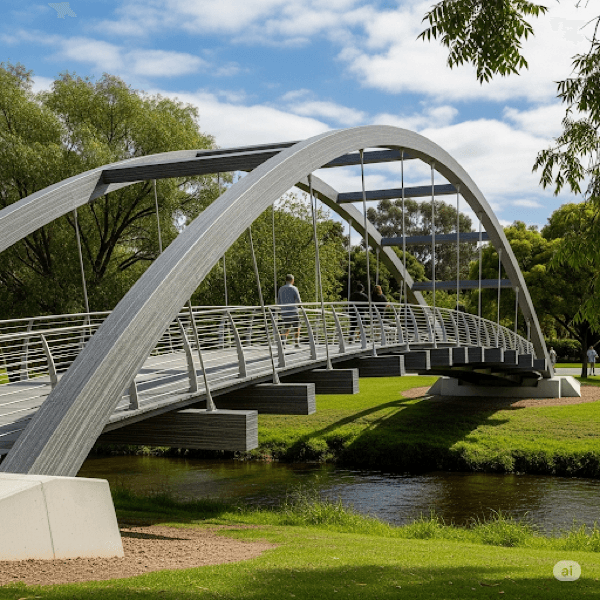
Bridge infrastructure worldwide faces a compounding maintenance crisis. Reinforced concrete decks corrode from de-icing salts, freeze-thaw cycles, and increasing traffic loads. Steel decks fatigue at welded connections and require ongoing protective coating programs. Fiber reinforced polymer bridge decks offer a fundamentally different approach: a lightweight, corrosion-immune structural deck system that changes how engineers design, build, and maintain bridge infrastructure.
Why FRP Bridge Decks
The core drivers for FRP bridge deck adoption are weight reduction, corrosion elimination, and rapid installation. These three advantages compound. A lighter deck reduces dead load on the superstructure and substructure, which in turn extends the service life of existing bridges that can be re-decked rather than replaced and reduces foundation demand in new-build work.
Weight Advantage
FRP bridge deck panels typically weigh far less than conventional reinforced concrete decks. The weight saving can reduce girder demand, lower seismic load, and make rehabilitation strategies possible on older bridges that cannot accept a heavy new deck.
Design Considerations
FRP bridge decks are stiffness-governed, not strength-governed. Because FRP modulus is much lower than steel, deflection criteria usually control the design. Connection detailing is equally important because the load path from deck to girder must manage fatigue, thermal movement, and maintainability.
Designers also need to consider wearing surfaces, long-term creep under sustained load, and the way the deck system interacts with steel or concrete support members. Good FRP bridge design is never just a panel problem. It is a complete structural system problem.
Installation and Social Cost
One of the largest practical advantages of FRP bridge decks is installation speed. Prefabricated modular panels can be lifted into place quickly, reducing closure time and the wider economic cost of traffic disruption. On busy routes, that benefit can be as important as the structural benefit.
Why Owners Continue to Evaluate FRP
The higher initial material price is real, but bridge owners are increasingly making decisions around lifecycle maintenance, disruption cost, and resilience in aggressive environments. FRP bridge decks are not a universal answer, but in the right rehabilitation and corrosion-driven projects they can be the highest-value answer.
F1 Composite supports bridge and access-structure teams with load-deflection analysis, system detailing, and pultruded deck concept development for fast-install infrastructure applications.