FRP vs Steel, Aluminium, Timber & Concrete
Fiber-reinforced polymer composites deliver a unique combination of high strength, low weight, corrosion immunity, and electrical insulation that no single traditional material can match. This page provides a detailed, property-by-property comparison to help engineers select the right material for their application.
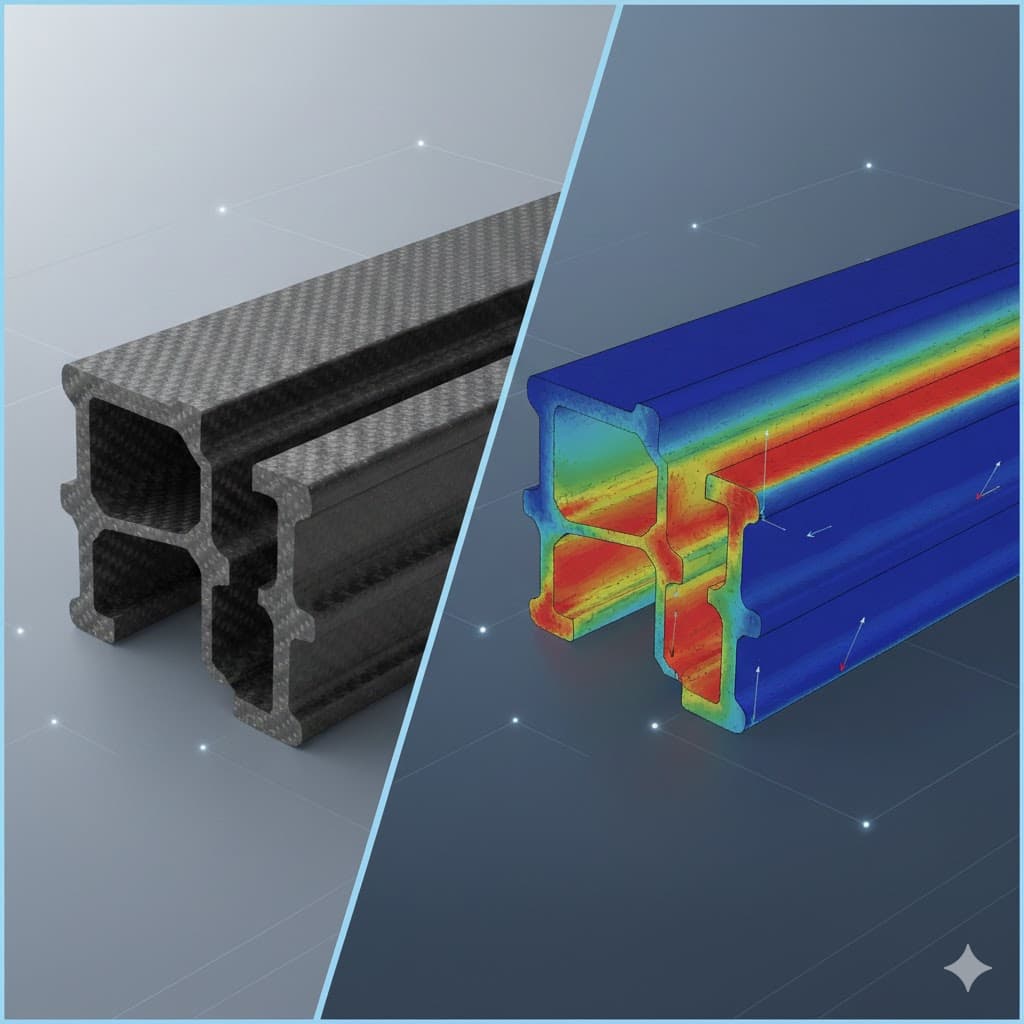
The Case for Fiber-Reinforced Polymers
Engineers and architects have relied on steel, aluminium, timber, and concrete for over a century. Each of these materials excels in certain properties, but every one of them carries significant limitations — steel rusts, aluminium conducts heat and electricity, timber rots and burns, and concrete cracks under tension. Fiber-reinforced polymers (FRP), manufactured by the pultrusion process, were engineered specifically to overcome these limitations.
An FRP composite is a material system consisting of continuous reinforcing fibers (typically glass, carbon, or aramid) embedded in a thermosetting polymer matrix (typically polyester, vinyl ester, or epoxy). The fibers carry the structural loads while the resin transfers stress between fibers, protects them from the environment, and defines the profile shape. This dual-component architecture gives FRP a set of properties that bridges the gaps between traditional materials — combining the strength of steel, the lightness of aluminium, and the corrosion resistance of high-grade stainless, while adding electrical insulation and thermal break capabilities that metals inherently lack.
The comparison below uses pultruded E-glass/isophthalic polyester FRP as the baseline composite — the most widely produced and cost-effective structural FRP system. Where carbon fiber or vinyl ester variants offer meaningfully different performance, we note those values separately.
Property-by-Property Comparison
The following table compares pultruded glass-FRP against commonly specified grades of steel, aluminium, timber, and reinforced concrete across the properties most relevant to structural, architectural, and industrial applications.
| Property | Pultruded FRP (E-glass / polyester) | Structural Steel (A36 / S275) | Aluminium (6061-T6) | Timber (Structural softwood) | Reinforced Concrete (C30/37) |
|---|---|---|---|---|---|
| Density (g/cm3) | 1.8 – 2.1 | 7.85 | 2.70 | 0.4 – 0.6 | 2.40 |
| Tensile Strength (MPa) | 350 – 700 | 400 – 550 | 260 – 310 | 50 – 100 (parallel to grain) | 2 – 5 (unreinforced) |
| Elastic Modulus (GPa) | 20 – 40 | 200 | 69 | 8 – 14 | 30 |
| Strength-to-Weight Ratio | Excellent | Moderate | Good | Good (parallel) | Poor |
| Corrosion Resistance | Immune | Poor — requires coating | Moderate — pitting in saltwater | Poor — rots in moisture | Moderate — rebar corrodes via chlorides |
| Thermal Conductivity (W/m·K) | 0.3 – 0.5 | 50 | 167 | 0.1 – 0.2 | 1.7 |
| Electrical Insulation | Excellent — non-conductive | None — highly conductive | None — highly conductive | Moderate (dry) | Poor (when wet) |
| Maintenance Requirement | Minimal — no painting | High — repaint every 8–15 years | Low–moderate — anodize or paint | High — stain/seal every 3–5 years | Moderate — crack repair, sealing |
| Lifecycle Cost (30 yr) | Lowest | High (corrosion maintenance) | Moderate | High (replacement cycles) | Moderate–high (repair costs) |
| CO2 Footprint (kg CO2/kg) | 3.1 – 5.0 | 1.8 – 2.5 | 8.0 – 12.0 | 0.3 – 0.5 (sequestered) | 0.1 – 0.2 |
Understanding Each Property
Density and Weight Savings
Pultruded FRP has a density of 1.8–2.1 g/cm3, which is approximately one quarter that of steel (7.85 g/cm3) and roughly 70 % of aluminium (2.70 g/cm3). In practical terms, an FRP profile that replaces a steel section of equivalent structural capacity weighs 70–80 % less. This weight reduction cascades through the entire project: lighter members require smaller foundations, lower-capacity cranes (or no crane at all — many FRP profiles can be carried by two workers), fewer transport loads, and less energy consumption during installation. For applications such as bridge decks, building facades, and offshore platforms, weight savings directly translate into cost savings and expanded design possibilities.
Tensile Strength
The tensile strength of pultruded E-glass FRP ranges from 350 to 700 MPa in the longitudinal (fiber) direction, which overlaps with and often exceeds the yield strength of structural steel (250–350 MPa for common grades). When carbon fiber is used as the reinforcement, tensile strengths above 1,000 MPa are achievable. The key distinction is directionality: pultrusion produces primarily unidirectional reinforcement, so transverse strength is lower — typically 50–100 MPa. For profiles that must resist multi-directional loads, we incorporate continuous filament mat and multi-axial fabrics to provide adequate off-axis strength, and we can optimize the fiber architecture for each application.
Elastic Modulus and Stiffness
The elastic modulus (stiffness) of E-glass FRP is 20–40 GPa, which is roughly one fifth to one tenth that of steel (200 GPa). This means that for a given cross-section size, an FRP member will deflect more than a steel member under the same load. In deflection-governed designs, this is addressed by increasing the moment of inertia of the FRP section — using deeper profiles, wider flanges, or hollow box shapes — or by switching to carbon fiber reinforcement, which raises the modulus to 100–150 GPa. Because FRP is so much lighter, the dead-load deflection contribution is significantly lower, partially offsetting the modulus difference in many real-world designs.
Corrosion Resistance
Corrosion resistance is the single most compelling advantage of FRP over metals. Carbon steel rusts in humid air, accelerates in salt spray, and suffers severe degradation in chemical environments — requiring continuous expenditure on protective coatings, cathodic protection, and periodic replacement of corroded sections. Aluminium, while more resistant than steel, is susceptible to pitting corrosion in chloride-containing environments and severe galvanic corrosion when in contact with carbon steel or copper.
FRP is inherently immune to electrochemical corrosion because it contains no metal. Vinyl ester and epoxy resin systems provide resistance to a wide range of acids, alkalis, solvents, and salt solutions at elevated temperatures. In chemical processing plants, wastewater treatment facilities, marine structures, and coastal buildings, FRP profiles can serve for 50+ years with zero corrosion-related maintenance — an economic advantage that often justifies the higher initial material cost within the first 5–10 years of service.
Thermal Conductivity and Insulation
FRP has a thermal conductivity of 0.3–0.5 W/m·K — roughly 100 times lower than steel and 400 times lower than aluminium. This makes FRP an inherent thermal break. In fenestration (window and door frame) applications, FRP frames eliminate the thermal bridging that is the primary source of energy loss through metal-framed openings. A building envelope using FRP framing instead of aluminium can reduce heating and cooling energy consumption by 15–30 % at the opening locations. In industrial applications, FRP structural members in cold stores, LNG facilities, and cryogenic environments prevent the condensation and ice formation that plagues steel structures.
Electrical Insulation
Glass-fiber FRP is an electrical insulator with a dielectric strength of 12–20 kV/mm, making it intrinsically non-conductive. This property is critical for electrical utility applications (crossarms, fuse cutout brackets, switchgear enclosures), railway electrification structures, and any environment where worker safety from electrical contact is paramount. FRP also has zero magnetic permeability, which is required for MRI room construction, electromagnetic compatibility (EMC) enclosures, and military applications where radar transparency is essential. No metal — including stainless steel and aluminium — can provide these properties.
Maintenance and Lifecycle Cost
The long-term cost of maintaining structural materials often exceeds the initial material cost. Steel structures in corrosive environments typically require full repainting every 8–15 years, with surface preparation (blasting), primer, and topcoat costing USD 30–60 per square meter per cycle. Over a 50-year design life, a steel structure may be repainted three to five times — adding 60–100 % to the initial material cost in maintenance alone. Timber requires staining or sealing every 3–5 years and is subject to insect damage, rot, and fire risk that further elevate lifecycle costs.
FRP profiles require essentially no structural maintenance. UV-stabilized resin systems and optional polyurethane topcoats provide decades of color retention and surface integrity. No painting, no cathodic protection, no preservative treatment. When full lifecycle cost is calculated — including installation, maintenance, downtime, and eventual disposal — FRP consistently delivers the lowest total cost of ownership for applications in corrosive, marine, and high-maintenance environments.
CO2 Footprint and Sustainability
The embodied carbon of pultruded FRP (3.1–5.0 kg CO2/kg) is higher than that of steel (1.8–2.5 kg CO2/kg) and concrete (0.1–0.2 kg CO2/kg) on a per- kilogram basis. However, because FRP is 75 % lighter than steel for equivalent structural capacity, the CO2 per functional unit (e.g., per meter of bridge rail, per square meter of grating) is often comparable to or lower than steel. When the avoided emissions from eliminated maintenance cycles (no repainting, no replacement) and reduced transport energy (lighter components, fewer truck loads) are included in a full lifecycle assessment (LCA), FRP frequently achieves a net carbon advantage over 30-to-50-year service periods.
Aluminium carries the highest embodied carbon of any common structural material at 8–12 kg CO2/kg, reflecting the enormous energy required for electrolytic smelting. Even with high recycling rates, primary aluminium production remains one of the most energy-intensive industrial processes. Timber sequesters carbon during growth, but structural timber production requires energy for kilning, treatment, and transport, and its shorter service life in exposed applications means more frequent replacement and associated emissions.
Explore Further
Frequently Asked Questions
Is FRP stronger than steel?
On a strength-to-weight basis, pultruded FRP is significantly stronger than structural steel. E-glass/polyester pultrusions achieve a tensile strength-to-density ratio roughly four times that of A36 structural steel. However, steel has a higher absolute elastic modulus (200 GPa vs 20–40 GPa for glass FRP), meaning it is stiffer per unit area. For applications where deflection governs the design — such as long-span beams — FRP profiles may need to be deeper or combined with carbon fiber reinforcement to match steel stiffness. Where corrosion, weight, or electrical insulation drives the design, FRP consistently outperforms steel.
What are the advantages of fiberglass over aluminum?
Fiberglass-reinforced polymer (FRP) profiles offer several advantages over aluminium alloys. FRP does not corrode in salt spray, acidic, or alkaline environments — unlike aluminium, which suffers pitting and galvanic corrosion when in contact with dissimilar metals. FRP is electrically non-conductive and thermally insulating, making it ideal for electrical enclosures, window frames (eliminating thermal bridging), and environments requiring electrical safety. FRP also has a lower embodied energy per kilogram when lifecycle impacts are considered, because it requires no smelting energy and no anodizing or painting. Aluminium retains an advantage in thermal conductivity applications (heat sinks) and where extreme ductility is required.
What are the main advantages of pultrusion over traditional materials?
Pultruded FRP profiles combine five key advantages that no single traditional material can match simultaneously: (1) Corrosion immunity — no rust, rot, or galvanic degradation, even in marine and chemical environments; (2) High strength-to-weight ratio — 75 % lighter than steel at comparable structural capacity; (3) Electrical and thermal insulation — inherently non-conductive, eliminating thermal bridging and electrical hazard; (4) Dimensional stability — zero thermal expansion in the fiber direction, and low overall CTE; (5) Design freedom — profiles can be engineered to precise strength, stiffness, and shape requirements through fiber architecture selection. These advantages translate into lower installation cost (lighter components, no crane required), lower maintenance cost (no painting, no cathodic protection), and lower lifecycle cost over 30+ year service horizons.
How does FRP compare to concrete for structural applications?
FRP is roughly 75–80 % lighter than concrete, which drastically reduces foundation loads, transport costs, and installation complexity. Unlike concrete, FRP does not crack under tensile loading, is immune to chloride-induced rebar corrosion, and requires no formwork or on-site curing time — profiles arrive ready to install. FRP also provides electrical insulation and zero magnetic permeability, which are important for MRI facilities, electrical substations, and electronics-sensitive environments. Concrete retains advantages in compressive-load-dominated applications (foundations, gravity structures) and where fire resistance beyond 2 hours is required, though FRP can achieve 60–90 minutes of fire resistance with intumescent coatings or phenolic resin systems.
What is the lifespan of pultruded FRP profiles?
Pultruded FRP profiles have a proven service life exceeding 50 years in outdoor, corrosive, and marine environments. Unlike steel, which requires repainting every 8–15 years and eventual replacement due to section loss from rust, FRP retains its structural capacity throughout its service life with minimal maintenance. Accelerated UV aging tests (ASTM G154) demonstrate that UV-stabilized polyester FRP profiles retain more than 90 % of their original flexural strength after the equivalent of 30 years of Florida-level UV exposure. Vinyl ester and epoxy systems perform even better in aggressive chemical environments. The combination of corrosion immunity, UV stability, and fatigue resistance means that FRP often delivers the lowest total cost of ownership over the full lifecycle of a structure, despite a higher initial material price compared to mild steel.
Need help selecting the right material for your project?
Our engineering team is ready to help you find the right FRP solution. Get in touch for technical consultation or a detailed quotation.