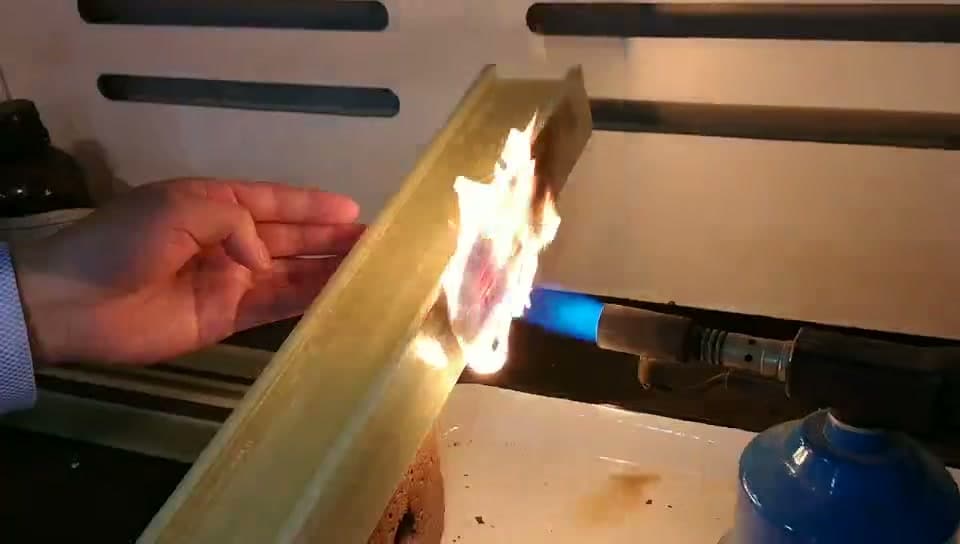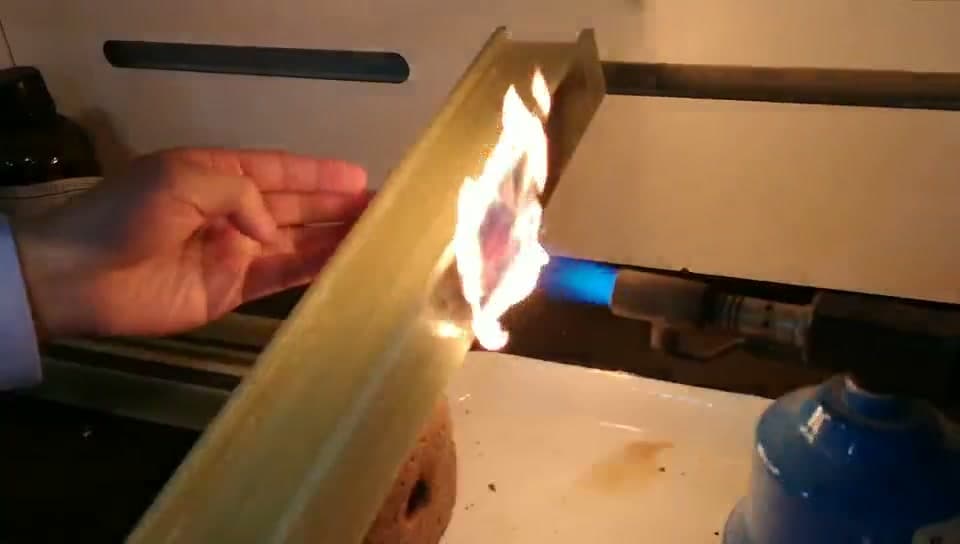
One of the most frequently asked questions about FRP composite profiles concerns fire. Engineers, architects, and building officials want to know: how do pultruded FRP structural shapes behave when exposed to flame? Can they meet building code fire requirements? And how do they compare to steel, concrete, and timber in fire scenarios?
These are fair questions. FRP profiles are made from organic polymer resins reinforced with glass fibers, and organic polymers are, by their nature, combustible. But "combustible" does not mean "dangerous in fire," and the fire performance of modern FRP composites is far more nuanced — and far better — than many specifiers assume.
How FRP Behaves in Fire
When a pultruded FRP profile is exposed to fire, a sequence of events occurs that is fundamentally different from how wood, steel, or unprotected plastic responds.
Phase 1: Surface decomposition and char formation. As the surface temperature reaches 250–350 °C, the outermost resin layer begins to decompose (pyrolyze). This decomposition produces a carbonaceous char layer on the surface. Critically, this char layer is not a weakness — it is a protective barrier. The char has very low thermal conductivity and acts as an insulating shield, slowing heat transfer into the profile interior.
Phase 2: Glass fiber reinforcement remains intact. Glass fibers are inherently non-combustible, with a melting point above 1,000 °C. As the resin at the surface chars, the glass fiber architecture remains structurally intact beneath the char layer. This is fundamentally different from timber, which loses cross-section as it burns, or steel, which rapidly loses strength above 400 °C and can collapse without warning.
Phase 3: Self-extinguishing behavior. When the external flame source is removed, properly formulated FRP profiles self-extinguish. The flame does not propagate beyond the zone of direct impingement. This is a consequence of both the resin formulation and the glass fiber content — the high volume fraction of non-combustible glass (typically 60–70% by weight in pultruded profiles) physically limits the amount of combustible material available per unit volume.
The Role of Resin Chemistry
Not all FRP is equal in fire performance. The resin system is the primary variable that determines a profile's fire rating, and the difference between a standard polyester and a fire-retardant phenolic formulation is substantial.
Standard polyester resin provides baseline fire performance. It is combustible and will sustain flame, making it unsuitable for applications with stringent fire requirements. It is typically used in chemical processing and underground environments where fire codes are less demanding.
Fire-retardant polyester and vinyl ester resins incorporate halogenated or non-halogenated flame-retardant additives, often in combination with aluminum trihydrate (ATH) fillers. ATH decomposes endothermically at approximately 220 °C, absorbing heat and releasing water vapor that dilutes combustible gases. These formulations can achieve Euroclass B or ASTM E84 Class 1 ratings.
Phenolic resin is inherently fire-resistant due to its aromatic chemical structure. When phenolic resin decomposes, it produces a dense, stable char layer with very low flame spread and minimal smoke. Phenolic FRP profiles routinely achieve Euroclass B s1 d0 — meaning low flame spread, very limited smoke production, and no flaming droplets. This makes phenolic FRP the preferred choice for railway, tunnel, and building interior applications.
Intumescent coatings can be applied to any FRP profile to add an additional layer of fire protection. These coatings expand when heated, forming a thick insulating foam that shields the underlying composite from heat for extended periods.
Fire Classification Standards
FRP profiles are tested and classified under the same fire standards as any other building material. The principal frameworks are:
EN 13501-1 (Euroclass system) is the European standard that classifies building products from A1 (non-combustible) to F (no performance determined). FRP profiles with fire-retardant resin systems typically achieve Euroclass B (limited contribution to fire), with sub-classifications for smoke production (s1 = low smoke) and flaming droplets (d0 = no droplets). This is the same class achieved by fire-rated timber products and gypsum boards.
ASTM E84 (Surface Burning Characteristics) is the North American standard that measures flame spread index (FSI) and smoke developed index (SDI). Class 1 (also called Class A) requires FSI of 0–25 and SDI of 0–450. Fire-retardant FRP profiles achieve Class 1 ratings, placing them in the highest fire-performance category alongside mineral fiber boards and fire-rated gypsum.
BS 476 (British Standard) includes tests for surface spread of flame (Part 7) and fire propagation (Part 6). FRP profiles can achieve Class 0 and Class 1 ratings under this framework.
EN 45545-2 (Railway applications) sets particularly demanding requirements for materials used in rail vehicles, including flame spread, smoke density, and toxicity. Phenolic FRP profiles meet HL2 and HL3 hazard levels required for passenger-carrying rolling stock in European rail applications.
Comparative Fire Performance
To put FRP fire performance in context, it is useful to compare it against conventional structural materials.
Steel is non-combustible (Euroclass A1) but loses 50% of its yield strength at approximately 550 °C and can undergo catastrophic collapse. Structural steel in buildings almost always requires fire-protective coatings, intumescent paint, or concrete encasement to achieve the required fire resistance rating. The cost of fire protection for structural steel is a significant but often overlooked line item in building projects.
Timber is combustible but benefits from predictable charring rates (approximately 0.7 mm per minute for glulam). Engineered timber products such as CLT are accepted in building codes up to 18 stories with appropriate fire design. FRP's char formation mechanism is analogous to timber's charring behavior.
Concrete is non-combustible and provides excellent fire resistance, but its high weight and thermal mass make it unsuitable for many applications where FRP excels — lightweight walkways, cable trays, offshore platforms.
Aluminum melts at 660 °C and loses structural capacity well before that point. In corrosive environments where aluminum might be considered as an alternative to FRP, the fire performance advantage of aluminum is marginal while its corrosion resistance is significantly inferior.
Where Fire-Rated FRP Is Already in Service
Fire-rated pultruded FRP profiles are deployed in demanding applications worldwide.
Railway and metro systems across Europe specify phenolic FRP profiles for platform screens, cable management systems, and interior panels. The EN 45545-2 compliance of phenolic FRP makes it a standard material in modern rolling stock, where low smoke and toxicity are critical for passenger safety in enclosed environments.
Tunnel infrastructure benefits from FRP's combination of fire performance and corrosion resistance. Cable trays, walkway systems, and structural supports in road and rail tunnels use fire-rated FRP where the combination of fire safety, durability in humid/aggressive environments, and lightweight installation would be difficult to achieve with any single alternative material.
Building facades and cladding increasingly specify fire-rated FRP for structural framing elements, particularly in curtain wall and rainscreen systems. Post-Grenfell regulations in the UK and revised EU Construction Products Regulation requirements have made Euroclass B the minimum acceptable standard for many facade applications — a standard that fire-retardant FRP meets.
Offshore platforms and marine vessels require materials that resist both fire and aggressive saltwater environments. Fire-rated FRP gratings and structural profiles serve dual duty in these applications, providing fire safety without the corrosion vulnerability of fire-protected steel.
Electrical and data infrastructure uses flame-retardant FRP cable trays and conduit supports in buildings, data centers, and industrial plants. The electrical non-conductivity of FRP is an additional safety benefit in these installations.
The Future of FRP Fire Technology
The fire performance of FRP composites continues to improve as resin chemistry, nano-additive technology, and manufacturing processes advance.
Nano-scale flame retardants such as nano-clay, carbon nanotubes, and graphene-based additives are showing promising results in reducing peak heat release rate and improving char quality without the environmental concerns associated with halogenated flame retardants. Research programs at European and Chinese universities are demonstrating 30–40% reductions in peak heat release with nano-additive loadings of just 2–5% by weight.
Bio-based flame retardant systems derived from phosphorus-containing natural compounds offer a pathway to FRP profiles that are both fire-resistant and more sustainable. These systems are still at the development stage but are expected to reach commercial availability within the next 5–10 years.
Hybrid intumescent-composite systems integrate intumescent functionality directly into the resin matrix rather than applying it as a surface coating. This approach eliminates the maintenance requirement of external fire coatings and provides fire protection that lasts the full service life of the profile.
Digital fire engineering using computational fluid dynamics (CFD) and finite element analysis (FEA) is enabling more precise prediction of FRP fire behavior in complex building geometries. As fire engineering moves from prescriptive codes to performance-based design, the ability to model FRP fire response accurately opens opportunities for FRP in applications where prescriptive material classifications would otherwise exclude it.
Conclusion
The fire performance of pultruded FRP profiles is a solved engineering problem, not an open question. Through the combination of fire-retardant resin chemistry, high glass fiber content, protective char formation, and self-extinguishing behavior, FRP profiles achieve Euroclass B s1 d0 and ASTM E84 Class 1 fire ratings — classifications that place them alongside the best-performing conventional building materials.
The torch test video at the beginning of this article illustrates the key principle: direct flame exposure produces localized charring with no flame propagation. This is not a material that burns and spreads fire. It is a material that resists fire through fundamental material science — non-combustible glass reinforcement, endothermic filler decomposition, and self-limiting char formation.
For engineers and architects specifying structural profiles in fire-regulated applications, the question is no longer whether FRP can meet fire requirements. The question is which resin system and fire classification best match the specific project requirements.