When engineers evaluate structural materials, they typically compare tensile strength, flexural modulus, and density. These static properties are well-documented and widely understood. But there is a critical performance dimension that static data sheets do not capture: what happens when a structural member takes an unexpected impact?
A falling tool on a walkway. A vehicle collision with a guardrail. Debris striking a facade panel during a storm. Wave impact on a marina structure. In all of these real-world scenarios, the question is not just "how strong is the material?" but "how does the material absorb and respond to sudden dynamic loading?"
Covestro's polyurethane research team conducted a rigorous comparative test that answers this question with remarkable clarity. Their 3-point bending drop test places seven common engineering materials under identical impact conditions — and the results challenge assumptions that many engineers hold about material toughness.
The Test Setup
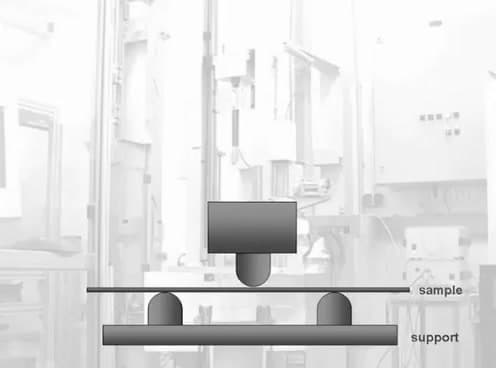
The experimental protocol is straightforward and rigorous. A falling weight is dropped onto the center of each sample in a standard 3-point bending configuration with a 320 mm support span. All samples are tested at 62 mm width. The metals and PVC are tested at 3 mm thickness, while wood (multiplex plywood) is tested at 9 mm — a concession to the fact that timber is never used at 3 mm in structural applications.
The seven materials tested represent the most common choices for structural and semi-structural profiles across construction, infrastructure, and industrial applications.
Material-by-Material Results
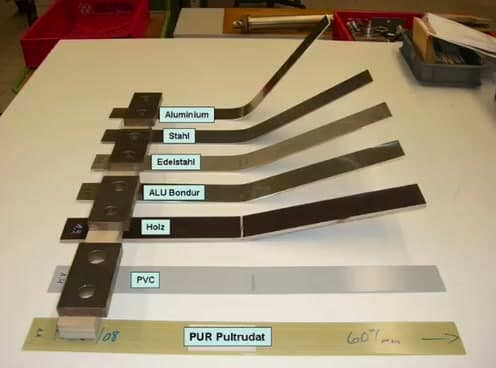
Sheet steel (ST 37, 3 mm) — The steel sample absorbs the impact through plastic deformation. It bends permanently at the point of impact and retains a pronounced curvature after the test. The material does not fracture, but it also does not recover. A steel component that takes this kind of impact in service is permanently damaged and must be replaced or repaired.
Stainless steel (V2A, EN 10259, 3 mm) — Similar behavior to carbon steel. The stainless steel sample deforms plastically and permanently. Despite its higher cost and corrosion resistance compared to carbon steel, its impact response is fundamentally the same: absorb energy through irreversible shape change.
Aluminum "Bondur" (AlCuMg1F40, 3 mm, k = 1.2) — This high-strength aerospace-grade aluminum alloy deforms severely under the drop impact. The permanent bend is clearly visible in the post-test comparison. High static strength does not translate to superior impact resilience — the aluminum yields and stays yielded.
Aluminum (Al99 5G11, 3 mm, k = 1.15) — The standard-grade aluminum shows the same pattern as the Bondur alloy: permanent plastic deformation with no elastic recovery. Both aluminum samples demonstrate that metallic materials fundamentally respond to impact through yielding — a one-way process.
PVC shock-resistant (3 mm, k = 0.68) — Despite being marketed as "shock-resistant," the PVC sample shows significant damage. PVC is a brittle thermoplastic that absorbs impact energy poorly. Under high-rate loading, it cracks or crazes rather than deforming gracefully. Its low k-factor (0.68) confirms inferior impact energy absorption compared to all other tested materials.
Wood multiplex (9 mm, k = 0.98) — Even at three times the thickness of the metal samples, the plywood specimen fractures. Wood fails in a brittle, catastrophic manner under impact — fibers break and the section loses all structural capacity. The k-factor of 0.98 is achieved only because of the significantly greater thickness.
PUR pultruded composite (k = 1.0) — The polyurethane pultruded profile is the standout result. After absorbing the full impact energy, the sample springs back to its original straight form. No permanent deformation. No fracture. No visible damage. The material absorbs the impact energy elastically and returns it, emerging from the test functionally identical to its pre-test condition.
Why FRP Outperforms: The Physics of Toughness
The dramatic difference between the pultruded composite and every other material in the test comes down to a fundamental distinction in how materials absorb energy.
Metals absorb impact through plastic deformation. When a steel or aluminum section is loaded beyond its yield point, the atomic crystal structure undergoes permanent dislocation movement. The energy is absorbed, but the shape change is irreversible. The material is "tough" in the sense that it does not shatter, but it is permanently damaged.
Brittle materials (PVC, wood) absorb impact through fracture. When the stress exceeds the material's fracture toughness, cracks initiate and propagate. The energy is absorbed by creating new crack surfaces, but the component fails catastrophically.
Fiber reinforced polymers absorb impact through elastic strain energy. The continuous glass fibers in a pultruded profile act as highly efficient springs. When the profile is loaded in bending, the fibers on the tension face stretch elastically while the fibers on the compression face store strain energy. Because the fiber volume fraction is high (60–70%) and the fiber-matrix bond is engineered to allow controlled micro-deformation at the interface, the total elastic energy absorption capacity is enormous.
Critically, this energy is recoverable. When the load is removed, the elastic strain energy stored in the glass fibers drives the profile back to its original shape. This is not merely "flexibility" — it is the combination of high strength and high elastic strain capacity that defines true toughness.
What the k-Factor Tells Us
The k-factor shown for each material in the Covestro video represents a normalized impact energy absorption metric. A higher k-factor indicates greater energy absorption capacity relative to a reference material.
The PUR pultruded profile achieves k = 1.0 (the reference), matching or exceeding the metals (aluminum Bondur at k = 1.2, aluminum Al99 at k = 1.15) in total energy absorption — but with a crucial qualitative difference. The metals absorb energy destructively (permanent deformation), while the pultruded profile absorbs energy constructively (elastic recovery). A pultruded profile with k = 1.0 that fully recovers its shape is functionally superior to an aluminum section with k = 1.2 that is permanently bent.
PVC at k = 0.68 and wood at k = 0.98 confirm what the visual evidence shows: these materials are simply outclassed in impact scenarios.
Engineering Implications
The Covestro drop test results have direct implications for material selection in applications where impact loading is a design consideration.
Guardrails and safety barriers. A steel guardrail that takes a vehicle impact must be inspected and typically replaced. An FRP guardrail absorbs the same impact and returns to service without maintenance. Over a 30-year infrastructure lifecycle, the replacement cost avoidance for FRP barriers in high-traffic locations is substantial.
Walkways and platforms. Industrial walkways and offshore platforms are subject to dropped-object impacts. FRP grating and structural profiles absorb these impacts without permanent damage, eliminating the inspection-repair-replace cycle that steel walkways require.
Marine structures. Dock fenders, pontoon frames, and marina walkways experience repeated wave-action impacts and vessel contact. FRP's elastic recovery means these structures maintain their geometry and function over decades of cyclic impact loading — conditions that progressively fatigue and deform metal structures.
Fenestration systems. Window frames in commercial buildings and residential high-rises must resist wind-borne debris impact (hurricane zones) and operational impacts (slamming, cleaning equipment contact). Pultruded FRP window frames absorb these impacts without the denting that affects aluminum frames or the cracking that damages PVC frames.
Transportation infrastructure. Bridge deck panels, highway sound barriers, and railway platform edges are subject to continuous vibration and occasional high-energy impacts. FRP's ability to absorb and release impact energy without accumulating fatigue damage makes it fundamentally better suited to these dynamic loading environments than materials that absorb energy through plastic yielding.
Conclusion
The Covestro 3-point bending drop test provides visual, quantifiable proof of what FRP manufacturers have long understood: pultruded fiber reinforced polymer profiles occupy a unique position in the engineering material spectrum. They combine the energy absorption capacity of metals with the elastic recovery of high-performance springs, while avoiding the permanent deformation of steel, the brittleness of PVC, and the fracture vulnerability of wood.
No other material in the test — not aerospace-grade aluminum, not stainless steel, not shock-rated PVC — could absorb the impact and return to its original form. Only the pultruded composite achieved this.
For engineers designing structures that must survive impact events and remain in service without repair, this is not a marginal advantage. It is a fundamental material capability that exists in pultruded FRP composites and in no conventional alternative.