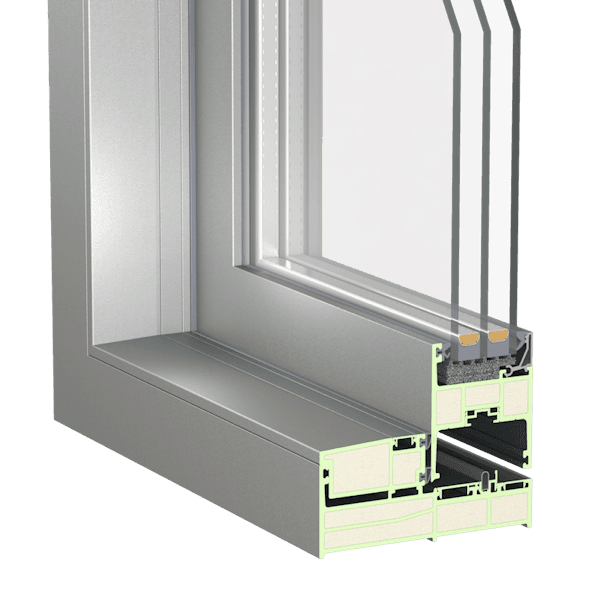
Aluminium has dominated the commercial window frame market for decades. Its strength, extrudability, and established supply chain make it familiar. But aluminium also has a fundamental engineering weakness that no amount of thermal break design can fully erase: it is highly conductive. Pultruded FRP window frames offer a structurally competitive alternative that solves the thermal bridge problem at the material level.
The Aluminium Thermal Bridge Problem
Aluminium transfers heat dramatically faster than FRP and many times faster than the insulated glass unit it frames. In a well-insulated wall assembly, that makes the frame a local weak point. The result is lower overall envelope performance, colder inside-surface temperatures, and higher condensation risk in heating climates.
FRP: Natural Thermal Insulation
Pultruded FRP profiles do not need separate thermal break strips to reach strong frame U-values because the entire section is already insulating. That simplifies the thermal logic of the frame and reduces the number of interfaces that must remain stable over decades of service.
Dimensional Stability
FRP also has a coefficient of thermal expansion much closer to glass than aluminium does. That helps maintain seal compression and weather performance as temperatures cycle. On long-life envelope systems, that compatibility is an important durability advantage.
Structural Performance
Pultruded FRP window profiles can deliver strong tensile and flexural performance while remaining relatively lightweight. That allows slimmer frame sections than PVC and competitive span capability versus aluminium in many window-wall and curtain-wall-adjacent applications.
Lifecycle and Sustainability
FRP frames do not corrode, do not require protective metal finishing to remain structurally sound, and can be engineered for long service life in coastal and industrial climates. The stronger the project's thermal target and the harsher the environment, the more serious the FRP-aluminium comparison becomes.
F1 Composite develops pultruded FRP frame systems for high-performance envelope applications where thermal performance and structural stability must be achieved in the same section.