"FRP composites cannot be recycled." For decades, this claim has been the single strongest objection raised against fiber reinforced polymer profiles in lifecycle assessments, green building certifications, and procurement specifications. Thermoset resins — polyester, vinyl ester, phenolic — cure through irreversible cross-linking, creating a three-dimensional polymer network that cannot be melted or reshaped. Unlike thermoplastic materials or metals, there was no practical way to recover the constituent fibers and resin from a cured composite part.
That limitation has now been overcome. A chemical degradation process developed under the TS Recycle program demonstrates full recycling of thermoset FRP composites at laboratory scale, recovering clean glass fibers suitable for reuse and reclaiming the process solvent in a closed loop.
The Recycling Challenge with Thermoset Composites
To understand why this breakthrough matters, it helps to understand what makes thermoset composites different from other engineering materials.
When a thermoset resin cures inside a pultrusion die at 120–180 °C, the polymer chains form permanent covalent cross-links. This is what gives FRP profiles their exceptional chemical resistance, dimensional stability, and long-term creep performance. But it also means the cured matrix cannot be re-melted. You cannot put a pultruded I-beam back through an extruder the way you can with a steel or aluminum section.
Previous recycling approaches for thermoset composites fell into three categories, none fully satisfactory. Mechanical grinding reduces cured FRP into filler powder, but destroys fiber length and most mechanical value. Pyrolysis burns off the resin at 450–600 °C, but degrades glass fiber strength by 50–70% and produces emissions that require treatment. Solvolysis using supercritical fluids works in laboratory settings, but requires extreme pressures (200+ bar) and temperatures (300+ °C) that make industrial scale-up prohibitively expensive.
How Chemical Degradation Works
The TS degradation process takes a fundamentally different approach. Instead of brute-force thermal decomposition, it uses a purpose-designed solvent system — the TS degradation solution — that selectively cleaves the ester bonds in the cross-linked resin network under mild conditions.
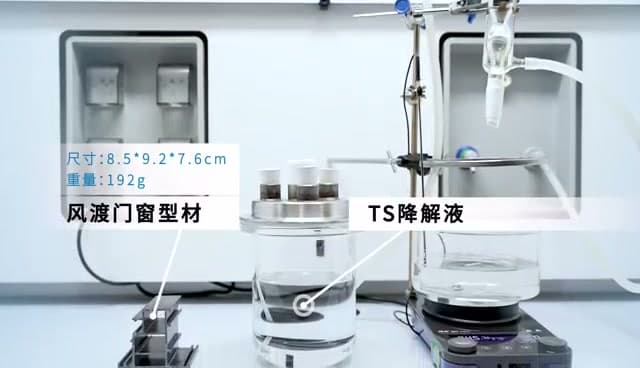
Step 1: Sample preparation The FRP component is cut to size for the reaction vessel. In the laboratory demonstration, a pultruded fenestration profile section measuring 8.5 × 9.2 × 7.6 cm and weighing 192 g was used as the test specimen — a real production part, not a specially prepared coupon.
Step 2: Immersion in TS degradation solution The profile section is placed in a sealed glass reactor containing the TS degradation solution. The reactor is mounted on a heated magnetic stirrer to maintain uniform temperature and solution circulation.
Step 3: Reflux degradation at 100 °C The reactor is heated to 100 °C and held at this temperature under reflux conditions. Over the course of the reaction, the degradation solution progressively penetrates and dissolves the cured resin matrix. The solution color changes from clear to amber to deep brown as dissolved resin oligomers accumulate. The mid-point of the reaction is reached at approximately 21 hours, with the reaction completing by approximately 41 hours.
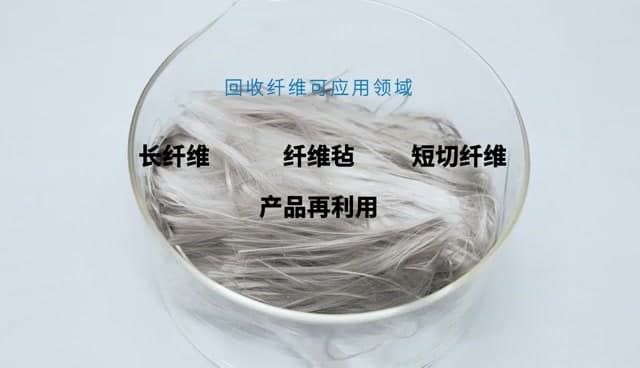
Step 4: Fiber recovery Once the resin matrix has been fully dissolved, the liberated glass fibers are extracted from the solution, drained, and washed with clean solvent. The recovered fibers emerge as clean, continuous bundles — not the short, degraded fragments typical of mechanical or thermal recycling methods.
Step 5: Solvent reclamation The spent degradation solution, now containing dissolved resin products, is transferred to a flask for vacuum distillation. This step separates and recovers the TS solvent for reuse in subsequent recycling batches, closing the material loop. The residual resin degradation products can be characterized for potential use as chemical feedstock.
What Gets Recovered — and How It Can Be Reused
The recovered glass fibers retain their continuous form and can be processed into several useful reinforcement formats. Long fibers can be used directly in hand lay-up, filament winding, or as supplementary reinforcement in new pultrusion. Chopped strands can serve as reinforcement in injection-molded or compression-molded parts. Fiber mats can be formed from the recovered fibers for use in resin transfer molding (RTM) or as surfacing veils.
This versatility is the key differentiator from mechanical recycling, where fiber length is destroyed, or pyrolysis, where thermal damage reduces glass fiber tensile strength to a fraction of its original value. Chemical degradation at 100 °C preserves fiber integrity in ways that higher-temperature processes cannot.
What This Means for FRP Specification
For engineers, architects, and procurement teams evaluating FRP profiles against lifecycle and sustainability criteria, the availability of a viable recycling pathway changes the conversation in several concrete ways.
Green building certifications. Standards such as LEED, BREEAM, and DGNB award credits for materials with demonstrated end-of-life recyclability. FRP profiles can now present a credible recycling pathway alongside their already strong durability and low-maintenance lifecycle performance.
EU regulatory compliance. The EU Waste Framework Directive (2008/98/EC) establishes a waste hierarchy that prioritizes recycling over energy recovery and disposal. The End-of-Life Vehicles Directive (2000/53/EC) sets recycling targets that composite components must address. A validated chemical recycling process provides a compliance pathway for FRP in these regulated applications.
Lifecycle cost analysis. When the residual value of recoverable glass fiber and reclaimable solvent is factored into whole-life cost models, the already favorable FRP lifecycle position improves further. A profile that lasts 50+ years without corrosion and can then be recycled into new reinforcement material presents a compelling total-cost case.
Carbon footprint reduction. Recovering glass fibers avoids the energy-intensive process of manufacturing virgin glass fiber from raw materials (melting glass at 1,400+ °C). Solvent reclamation minimizes chemical waste. The net carbon impact of recycled-content FRP profiles could significantly undercut that of virgin-only production.
The Road from Lab to Industrial Scale
It is important to be transparent about where this technology stands today. The TS Recycle process has been demonstrated at laboratory scale with real production parts. The chemistry works. The fiber quality is validated. The solvent recovery loop is proven.
Scaling from laboratory reactors to industrial continuous processing is the next engineering challenge. Key questions include reactor sizing for full-length profile sections, throughput optimization, quality assurance for recovered fiber properties, and cost modeling at production volumes. These are engineering problems, not fundamental science barriers — the kind of challenges that the composites industry has successfully solved before, from batch curing to continuous pultrusion.
F1 Composite is committed to advancing this technology as part of our broader sustainability strategy under the TS Green initiative. We believe that demonstrating a credible, low-energy recycling pathway is essential for the continued growth of FRP as a structural material in applications where lifecycle responsibility is non-negotiable.
Conclusion
The long-standing objection that thermoset FRP composites cannot be recycled is no longer valid. Chemical degradation at 100 °C using a purpose-designed solvent system can fully dissolve cured polyester and vinyl ester matrices, recover clean glass fibers for reuse, and reclaim the process solvent in a closed loop.
This is not a theoretical possibility — it is a demonstrated laboratory process applied to real pultruded fenestration profiles. As the technology scales toward industrial application, it closes the last major gap in the FRP sustainability story: a material that already outlasts steel by decades, requires no protective coatings, and generates no corrosion runoff can now also be recycled at end of life.
For specifiers weighing FRP against traditional materials on lifecycle grounds, the equation has fundamentally shifted.